Tibor Galamb
TIBOR GALAMB
CONCEPTUAL CATEGORY WINNER
Tibor Galamb is a Hungarian conceptual and still life photographer known for constructing meticulously staged visual narratives that balance precision, symbolism, and subtle humor. His work explores the relationship between objects and meaning, often transforming everyday materials into poetic or thought-provoking compositions. With a strong foundation in lighting craft and set construction, he approaches photography as a form of visual storytelling rather than documentation. Over the years, his photographic voice has evolved from purely aesthetic still life studies into concept-driven imagery where form serves idea. He is particularly interested in creating images physically in front of the camera, building real sets and using practical effects to maintain authenticity and tactile presence in an increasingly digital visual culture.
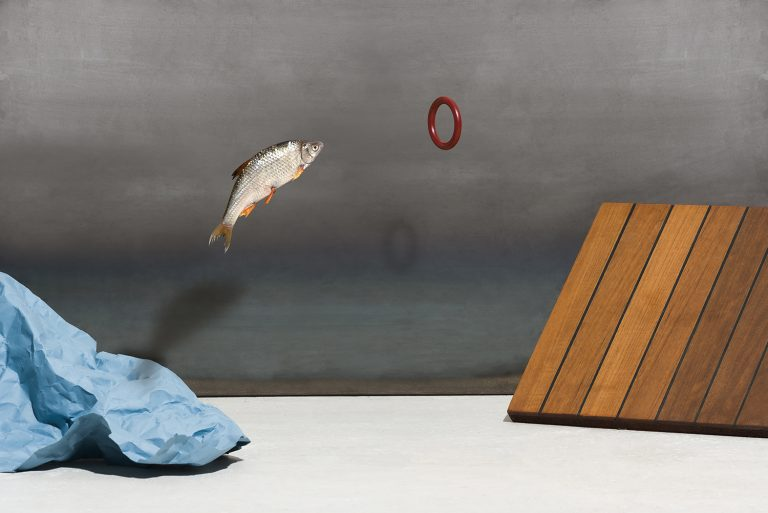
The core idea was to visualize tension between nature and artificial intervention. I wanted to create a scene that feels slightly impossible yet believable at first glance. The concept evolved through sketching and testing object relationships until I found a balance where the elements felt suspended between reality and metaphor.
I approached it like set design. Every object was carefully selected for texture, color contrast, and symbolic weight. Placement was calculated to guide the viewer’s eye across the frame and create a visual narrative path. Lighting was crucial—it defines space, mood, and realism, so I refined it until the scene felt natural despite its constructed logic.
The floating fish represents fragility and displacement, while the red ring suggests both target and passage. The wooden surface introduces stability and human order, contrasted with the organic subject. Together they form a quiet dialogue about control, environment, and perception.
Post-production was minimal and mainly corrective. My goal is always to build as much as possible physically during the shoot. I use retouching only to refine—not to invent. For me, the authenticity of real light and real objects gives the image its credibility.
I focus on visual clarity. If composition, lighting, and object relationships are precise, the image can communicate intuitively. I prefer leaving space for interpretation rather than dictating meaning, because ambiguity invites engagement.
The biggest challenge is translating an abstract idea into physical reality. What works in imagination does not always obey gravity, balance, or physics. Solving those practical problems—rigging, positioning, timing—is often the most demanding but also the most rewarding part of the process.
This recognition is very meaningful because conceptual photography is deeply personal work, and having it resonate internationally is encouraging. My advice is to prioritize ideas over equipment. Strong concepts will outlive trends. Be patient, experiment physically, and don’t be afraid of failure—most successful images are built on many unsuccessful attempts.